Once a year, a working sailboat comes out of the water. A travel lift picks it up in slings, and for the first time in months you can see what it's been dragging around: barnacles along the keel, a beard of weed over paint that was clean last spring. Someone in coveralls spends the afternoon scraping. Then the hull gets inspected, patched where it needs it, painted and lowered back in. The boat sails better for the rest of the year because it stopped sailing for a few days.
People who run businesses almost never do this for themselves. They plan the company's year in detail. Then they let their own year happen to them, and wonder in November why everything feels slow.
What I do every winter
For a few years now, every December or January, I end all my recurring meetings. All of them.
Then I step back, look at the calendar, and start from one question: what do I want to accomplish in the next year? I rebuild my time and my meeting cadences around the answer. ("Everything on the driveway" is about the teardown itself, and what earns its way back in.)
The order matters. Start from the calendar you have and you end up defending it. Every recurring block has a reason, and the reasons all sound fine when you read them one at a time. Start from the year you want and the calendar has to argue its way back in.
You can't see a hull from the deck. Weekly planning looks at this week. It will never show you what's been growing under the waterline since last January.
Every year is a season
The question gets a different answer every year, because the years aren't the same.
Some years are a season of growth. Some are a season of getting close to the customer, and the calendar has to free up real time to spend with customers. Some years you're buckling down financially. And some years the biggest goals are personal. For me, that's meant more time with my kids.
Each of those seasons wants a different calendar. A year of growth and a year of buckling down shouldn't have the same meetings in them. If your calendar looks the same every January, you're running last year's season whether you meant to or not.
Doing it with a whole organization
I do this in business too, with teams and with entire organizations. It freaks people out the first time. Then they're like, oh yeah, that makes sense.
At the start of the year, or before it, reaffirm what you're trying to accomplish. Then look at the decisions already on the books and ask whether each one supports that target. If it doesn't, change it. We don't have to stick with what we've been doing.
In most cases, doing what we've done won't give us the same success that got us to this point. The discipline might look similar. But doing the exact same thing in a $100,000 business that you do in a million-dollar business is not going to get you the same return. Habits that fit the smaller company are barnacles on the bigger one.
Meetings are usually where I start, because they're where drift shows up first in a company. ("Look for the drift" goes into why.) A calendar full of standing meetings is a record of what the organization used to think was important.
And once isn't enough. As you grow and learn, and as the market moves under you, keep asking whether the way you spend your time and focus still lines up with what you're trying to accomplish.
Between haul-outs
A boat gets hauled once a year. A year is a long time to steer without checking.
If you're heading into a stretch with hard, clear decisions in it, block regular planning sessions with yourself. How often depends on how much stress the job puts on you. A day every month or two works: a day just to replan the next three months, what you need to get done, and your work-life balance if that's been a struggle.
Those days are the first thing people give away when the week gets full. Put them on the calendar in January, while it's still empty and you've just decided what the year is for.
Once a year you stop sailing, so the rest of the year sails better.
Where the metaphor breaks
A boat can't sail while it's on stands, and you can't fully stop. The company keeps running and someone at home still needs dinner. Ending every recurring meeting doesn't end the work. Plenty of meetings come back. They come back because you chose them.
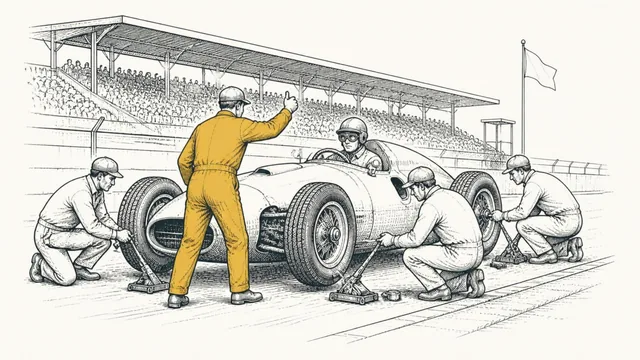
A boat in the yard also has a surveyor who isn't the boat. You're inspecting yourself, and you'll go easy on the things you like doing. Read the plan to someone who'll tell you the truth. ("The pit crew" is about those people.)
And barnacles are all bad. Your calendar isn't all clutter. Some of what built up over the year is the work that's going well. Scrape the hull, and leave the keel on.
Try this
- Pick a date in December or January and put it on the calendar now.
- Before that date, write one sentence on what you want to accomplish next year. Name the season: growth, close to the customer, buckling down, or something personal.
- On the day, end every recurring meeting you own.
- Rebuild from the sentence. Put back only the cadences that serve it.
- If you lead a team, tell them what you're doing and why, then do it with them. Expect it to freak people out once.
- Block a planning day with yourself every month or two for the rest of the year.
Where do you land?