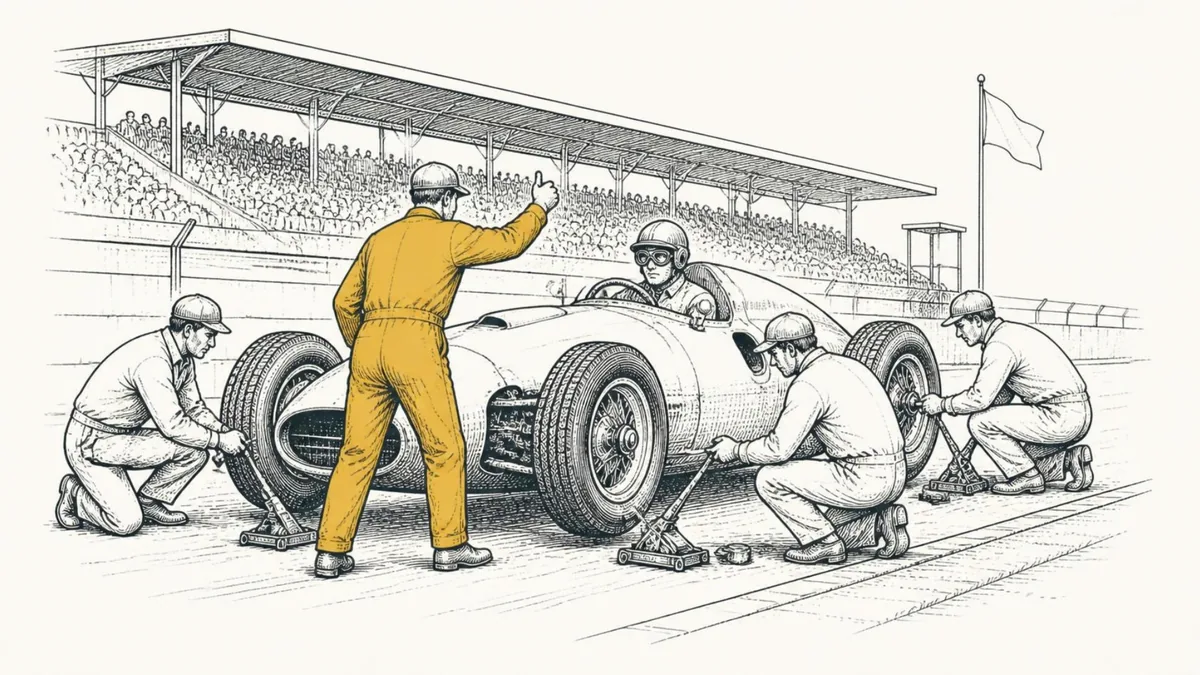
Watch a pit stop and the thing you notice is how little the driver does. The car comes in hot and stops on its marks. The crew is already there, holding the tires and the jack and the wrenches. The driver keeps their hands on the wheel. A few seconds later someone signals, and the car is gone.
Now picture the same driver with no crew. You don't know when your tires are bald, or when it's time to take them off. Nobody holds the car steady while you make changes. You're on the side of the road, lifting the car yourself, and it takes much longer.
That's how a lot of people who run things live. Something goes wrong and they climb out and fix it alone, slowly. They tell themselves that's the job. It's just the slow way to do it.
No yes-people
I don't have yes-people in my inner circle. Everyone in it will tell me where I can improve, or where I'm not doing something well.
A crew is not a cheering section. If everyone you call tells you you're right, you've built a fan club, and a fan club can't change a tire.
"You're a terrible best friend right now"
My best friend once said to me, "You know what? You're a terrible best friend right now."
I said, "Wait, what?"
"I've called you several times and you're not responding. You haven't asked me at all about what's going on with me. Right now you're being a terrible friend."
I've learned so much about friendship and relationships from him.
Look at what he did. He didn't say it to hurt me. He said it so I could do something about it. The people who are honest with you so you can act on it are the people who care.
And notice which way it ran. He wasn't helping me with a work problem. He was telling me I'd stopped showing up for him. A crew that only ever works on your car, and never gets anything back, starts to look a lot like staff.
What my crew does
The people on my crew let me think something through, and they help me think it through.
Sometimes one of them will say, "I don't understand it, but it seems to make sense to you." That's its own kind of help. They aren't pretending to follow, and they aren't stopping me either. Other times the question is simpler. "Why do you want to do that?" Or, "What brought you to this?"
Those questions are the bald-tire check. You can't see your own tread from the driver's seat.
At the time, sometimes it's grating. I haven't always loved it in the moment. But it is so healthy.
Why drivers end up alone
Part of it is that the people around you at work are badly placed to do this. The people who report to you have reasons to shade the truth, however good they are. Your boss is also the person grading you. Investors want the car to win, which isn't quite the same as wanting you to be all right.
Part of it is pride. Asking for help feels like an admission, and the higher up you go, the more it seems like you should already know.
And part of it is that nobody builds a crew on purpose. People have friends and colleagues and a few people they call sometimes. A crew is the small number of them who'll tell you the truth, and who have enough access to your life to see what's actually going on.
Through the seasons
A trusted crew with access lets you get through the changes in the seasons of life faster. A new role. A year when home needs more of you than work does. The tires wear differently in every season, and somebody has to notice before you're on the shoulder with the jack out.
Nobody wins a race changing their own tires.
Where the metaphor breaks
A pit crew works for the driver. Yours doesn't. They have their own races and their own bad weeks, and they help you because they want to. Ask what's going on with them. My best friend had to remind me of that one.
A crew also isn't a board. It doesn't vote and it doesn't decide. You'll hear advice that contradicts itself, and some of it will be wrong. You still drive the car.
And real crews are hired for skill. Yours is usually built from whoever happened to be around. Every so often, look at who you actually call and ask whether they still tell you the truth, or whether they've drifted into agreeing with you.
Try this
- Write down who you'd call this week if a big decision went wrong. The names you'd actually dial.
- Next to each name, write the last time they told you something you didn't want to hear. A blank line is information.
- Call one of them and ask how they're doing, before you bring up anything of yours.
- The next time you're about to commit to something big, ask one person, "Why do you think I want to do this?" and let them answer.
- When the feedback grates, write down what they said before you argue with it.
Where do you land?