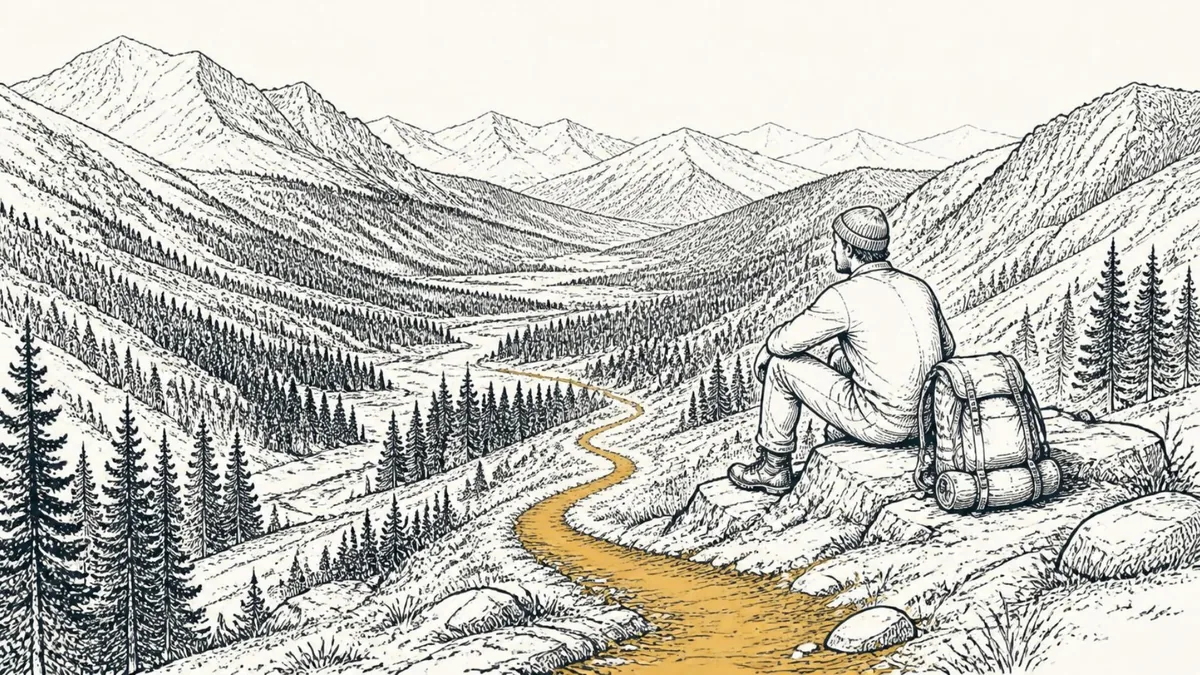
On the way up a mountain you mostly see your feet. A root, a loose rock, the next switchback, the back of whoever's ahead of you. The trail turns left, then right, then doubles back on itself, and for long stretches it seems to be heading away from the summit. You keep walking because the blaze on the next tree says to.
Then you come out on the ridge, sit down, and look back. The whole thing is down there. Every switchback you cursed is part of one line, and the line was going somewhere the entire time. You just couldn't see it from inside the trees.
Careers work like this. From inside each job, the job is the whole world. Then you change jobs, and the new one is. String a few together and a career can feel like a set of unrelated climbs. Most people never stop long enough to look back from the ridge.
Titles are blazes on trees
The usual way to look at a career is the résumé, and the résumé hides the trail. Titles, companies, dates, a few bullets each: trail markers with the trail removed.
Titles are the weakest part. They tell you what the org chart called you. Two people with the same title can spend years on completely different problems.
What connects the jobs is usually the kind of problem you were brought in to solve. The industry and the function change around it.
Mine started in film school
I went to school for film. What I learned there is that I loved having an idea and then working with a group of people to see it come to life.
Then my career moved into digital and went in a lot of directions: finance, fintech, pharmaceutical work, management consulting. On paper that's plenty of switchbacks. From the ridge it's one trail, because companies and teams are groups of people with an idea of what will be valuable, and my work has been helping them make it real.
When I finally wrote down the problem I keep getting handed, it came out as a question:
"How do we get a group of people to see the same vision and to work towards it when we don't have the same skills and we're not starting from the same place?"
Three stretches of the trail
At Gannett I was one of five people on the Design Innovation Group, which reported to the CEO. Five people, different skill sets. One of the group's jobs was building a process for enterprise-level innovation that could be reused, and I co-authored a 120-page innovation manual combining Agile, human-centered design, UI/UX and disruptive innovation. A manual like that exists for exactly my question: people from very different corners of a big company, trying to work on new ideas the same way.
At Personify the shared thing was a design system. Personify sold a core product to large nonprofits, and customers paid for customizations to fit how they ran their programs and memberships. Every customer started from a different place. A product-specific design system meant the core product and every customization were built from the same parts, so a solution made for one customer could move to the next instead of being built from scratch. Development cost and time dropped 30%, and the practice grew 300% in 24 months.
At Guidehouse I was on the partner track, and I evolved the innovation lab into an incubator and a rapid-response capability. The shift that mattered was, in our words, becoming "a great incubator, not just a great innovator." We got really good at coaching teams to quickly work out what was important and build what mattered, instead of building up our own expertise so we could build what we thought mattered. Zero-to-one launches got 70% faster across that practice. Same question again. The teams didn't have our skills and didn't start where we did. The job was getting them to see the same thing and move on it.
Media, enterprise software, consulting. One trail.
Write down the one big job
Your turn. List every role you've had, going as far back as feels useful. Next to each, write one line: the big job it came with. Skip the title and the responsibilities. Write the problem.
The problem is usually the reason someone hired you or moved you, whether or not they said it out loud. Be honest about the ones you didn't solve. A problem you were handed and failed at still tells you what people thought you were for.
Then read the list top to bottom and look for repeats. The shape of the problem survives a change of industry, company size and title. One person keeps getting handed the messy thing that needs to become repeatable. Another keeps getting sent in when something's already on fire. Those are only examples. Yours will be in your own words.
Other people often see the shape before you do. If you can't find it, ask a few people who've worked with you: "When you've sent something my way, what kind of thing was it?" Don't argue with the answers. Write them down.
Name it in one sentence
Then write the pattern as one sentence. Most people stop at something too soft to use. "I help organizations grow" is a sentence nobody could disagree with, which is the problem with it. A useful sentence is specific enough that some jobs clearly fall outside it.
It doesn't have to be a statement. Mine is a question. A question you keep getting handed is still a trail.
Use the trail to choose
The point of seeing the trail is to make the next fork easier. Every new request gets a quick test: is this on the path, or a scenic detour?
On the path means the same kind of problem, maybe bigger, maybe somewhere new. The sentence makes saying no easier. "That's a good project, and it isn't the kind of problem I'm best at" is a clean no. Without the sentence you end up saying yes to whatever's flattering, and flattering requests are where careers wander off into the trees.
Detours aren't always wrong. Some teach you what the main trail never would. Take them on purpose.
The title is the blaze. The problem is the trail.
Where the metaphor breaks
A hiking trail was cut before you got there. Someone planned it, graded it and painted the blazes. A career wasn't laid out in advance, and reading one backward can turn into a tidier story than the truth. Some moves were luck. Some were money, or family, or a bad boss you needed to get away from. The trail you see from the ridge is real, but you drew some of it after the fact. Hold it loosely.
You also don't have to keep walking it. Being handed the same problem for fifteen years can mean you're very good at it, or that you're tired of it. The ridge is a fine place to decide the next stretch goes somewhere else, as long as you know what you're leaving.
Try this
- List every role you've had. Next to each, write the one big job it came with, as a problem, in a single line.
- Mark the problems you solved, the ones you didn't, and the ones you still think about.
- Read the list for repeats and circle the shape that shows up most.
- Ask three people who've worked with you what kind of thing they used to send your way. Write their answers next to the list.
- Write one sentence, or one question, for the problem you keep being handed. Keep it where you'll see it the next time someone asks you to take something on.
Where do you land?