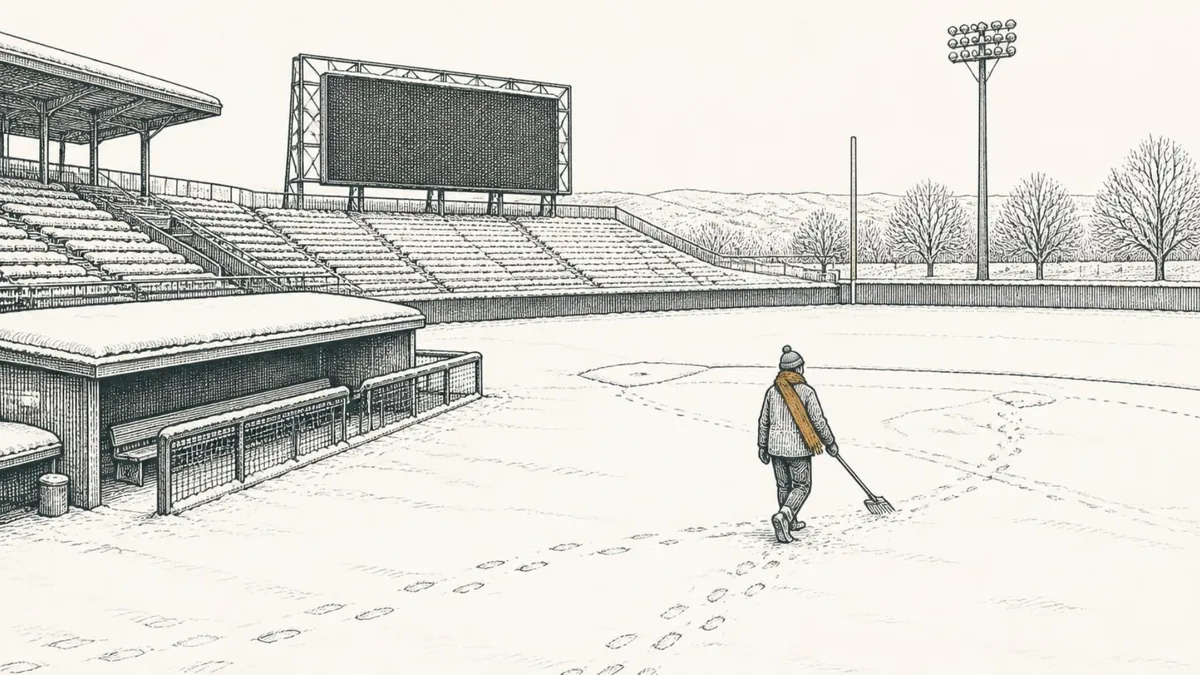
Go to a ballpark in January. Snow on the bleachers, the scoreboard dark, the gates chained. One groundskeeper walking the field, checking on the grass under the snow.
Nobody looks at that and thinks the team has given up. The off-season is on the schedule like everything else. Players rest, properly. Then they prepare, on a plan, so they show up in spring ready for a long season instead of hurt by May.
Most people who run things have no off-season. They have a season that never ends, broken up by a week at the beach with a laptop. They rest when they break: when they get sick, or burn out, or get so short with people that someone pulls them aside. That's the most expensive kind of rest, because you don't get to choose when it comes.
"The yearly dry dock" is about rebuilding the calendar around the year ahead. This one is about the person who has to live inside that calendar.
Mine is mostly preparation
My off-season is mostly preparation. Some of it is recharging. And some of it is getting perspective back on why what I do matters, and how it can affect people.
The preparation comes down to a few questions:
- Are there things I want to learn that will matter for the next season?
- Is something about how I operate holding me back, turning into kryptonite, or draining me? What do I want to shift?
- What do I want to do more of, because it's more in tune with who I am and more helpful?
Those questions are about the person. The calendar follows from the answers.
Has work drifted from the rest of me?
The off-season is also when I reconnect with family and friends, and ask a harder question. Has my business experience diverged from my human experience in an unhealthy way? From my experience as a dad, as a husband, as a friend?
That question comes from a job I had shortly after college.
Lied to all day
For a short time I worked in insurance claims. People lied to me every day, all day.
After a while I realized it was affecting how I dealt with people outside work. Friends. Family. The job had followed me home.
That's the kind of drain that never shows up on a calendar. You don't schedule it. You carry it home.
So in my off-season I look for the things I'm continually bringing home. Then I solve for them, change them, or put protections in place so they stop coming through the door. ("Your battery, not your calendar" is about the other side of this: what charges me back up.)
Where I rebalance
My off-season is about preparation, understanding and recharging. Ultimately it's where I rebalance myself as a person.
It's never just about work. It's about me as a human, a person, a husband, a dad, a partner, a consultant, an advisor, a friend, a neighbor. Only a couple of those are job titles.
So I ask: How do I show up in the world? Do I like it? Is it who I want to be? Then I make a conscious decision.
That's the part athletes and the rest of us share. The off-season is where you decide who shows up in spring.
Rest still counts
Preparation is no excuse to work through the break. Answering email from a beach isn't rest, and neither is a quick check each morning. The test is simple: did the load actually come off?
Rest doesn't have to mean lying down. A long walk, cooking, time with people who don't care what you do for a living. What matters is that work stops asking things of you for a while, so the questions above get honest answers.
Where the metaphor breaks
A league sets the off-season for every team at once. Nobody sets yours. Your customers keep buying, your competitors keep shipping, and no commissioner tells you to stop. You put it on the calendar yourself and defend it.
Some seasons won't allow much of one: a startup's first year, a family crisis, a company in real trouble. Don't feel guilty about a year like that. Follow it with a longer break, not another hard year.
And athletes rest so they can perform. You can rest for that reason too, but you don't have to. Rest is allowed to be for you.
Try this
- Block an off-season in the next twelve months now, before the year fills up. Mark it busy.
- Write down your answers to the three preparation questions: what to learn, what's draining you, what to do more of.
- List what you keep bringing home from work. For each item, pick one: solve it, change it, or put a protection in place.
- Ask someone at home whether work has been showing up at the dinner table. Believe the answer.
- Write the list of who you are outside your title. Ask of each one: is this who I want to be?
Where do you land?