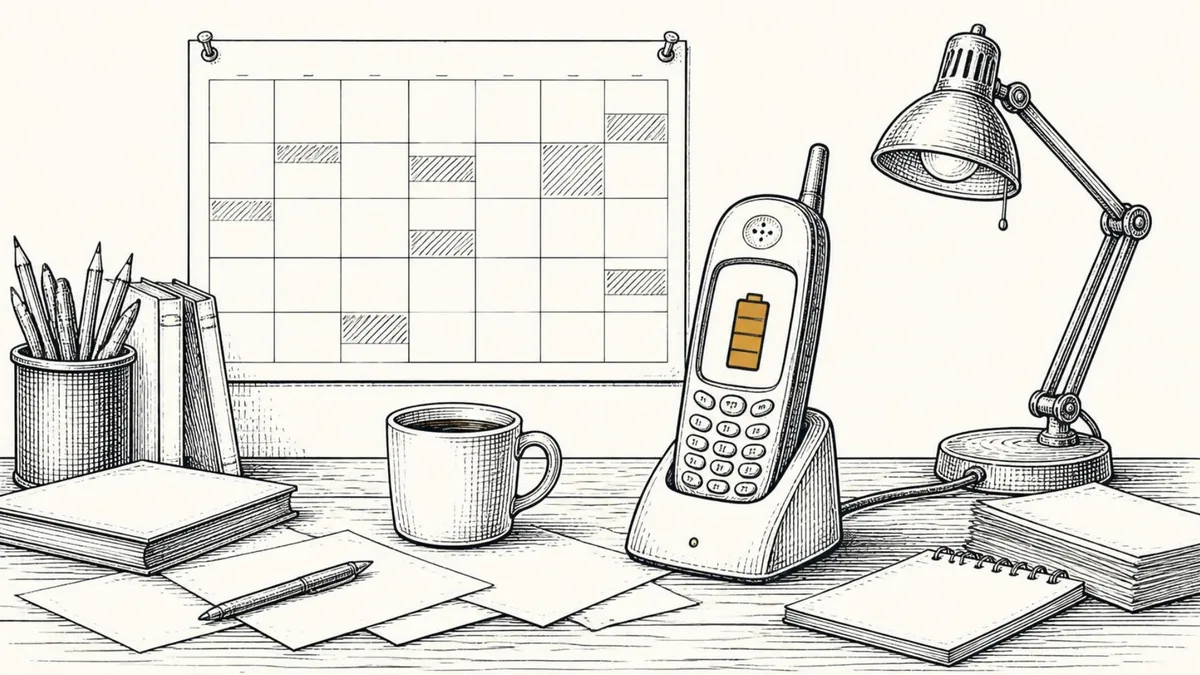
You charge your phone overnight and it leaves the house at full. By two in the afternoon it's in the red. You didn't use it more than usual. So you open the battery screen and there it is: one app you opened twice ate most of the charge, while the one you used all morning barely registered.
The phone keeps score in charge. Minutes barely come into it.
Your calendar works the other way. It's a grid of hours, and every hour is the same unit. That's a fine way to schedule a room. It's a bad way to schedule a person, because you run on a battery, and some hours cost far more than others.
Hours are the wrong unit
Picture two one-hour meetings on the same Tuesday. In the first, you're at a whiteboard with an engineer working out how a feature should behave. You argue, you draw, you get it wrong twice and then right. You walk out with more energy than you walked in with. In the second, you're defending a number you didn't set to people who've already decided it's wrong. Nobody raises their voice. You walk out flat.
The calendar records both as sixty minutes. Your battery doesn't.
So the useful question is what charges you and what drains you, as specifically as you can say it. Here's mine.
What charges me
Perspective. And, for the way my brain works, disparate inputs. I learn allegorically: something in one place ties something together somewhere completely different.
I'll be watching National Geographic, something about the behavior of arthropods on the forest floor, and it sparks something that makes sense for a software problem. Or a people problem. Or an organizational problem a client is stuck on. The documentary had nothing to do with work. That distance is what makes it useful.
It's also why I love to travel. Fortunately, my wife does too. I love people. People are absolutely amazing. My work is about people: working with them toward a goal, understanding what they want and need, and balancing what they can and can't communicate. When you're surrounded by the same people and the same experiences all the time, you forget how much variance there is in people, and how amazing human beings are.
When I land somewhere completely different, my first thought is this. All these people have lives as rich and full as mine. A wealth of memories and experiences. And they've never met me. I'm but a small grain of sand on a beach of humanity.
That thought gets me thinking differently. It keeps me right. And the conversations I have with people whose experiences are nothing like mine surface things I'd never find at my desk.
So new things, new places and different people charge me. Specifically, being with people in situations that have nothing to do with business.
What drains me
In "AI should be a supersuit, not a severance package" I write about superpower and kryptonite: amplify the superpower, protect against the kryptonite. Kryptonite covers more than the things you're weak at. It includes the things that drain you and drain your value.
The drain I still think about was a short job in insurance claims, not long after college. People lied to me all day, every day, and it started to affect how I dealt with people outside work. I tell that story in "The off-season", because what I learned from it is part of how I spend mine.
That's the drain worth watching for: the one that doesn't stay at work. A bad meeting costs you an afternoon. A drain that follows you home costs a lot more, and it never shows up on the calendar.
Protect the chargers
Charging work has a bad habit of looking optional. It rarely has a deadline and nobody else is waiting on it, so it's the first thing to go when the week fills up. Then the week gets harder, because you cut the thing that was refilling the tank.
My chargers look even more optional than most. A documentary. A trip. A long conversation with someone who doesn't care what I do for a living. None of that looks like work on a calendar. It shows up in the work anyway, as a connection I wouldn't have made otherwise.
So plan for charge as well as time. Put the big drains where you'll have the most charge, and leave a gap after each one. Put a charger after a cluster of drains, before the work that needs you sharp. A week planned that way has fewer meetings in it than a week planned by open slots. That will feel uncomfortable at first.
Your calendar counts minutes. You spend charge.
Where the metaphor breaks
A phone battery is predictable. Yours isn't fully in your control. You get sick, someone you care about needs you, a week goes sideways. Some weeks drain you no matter how carefully you plan them. That's a bad week, and the method can survive it.
A phone also charges from one cable. People don't. What fills you up might look nothing like what fills up the person next to you, and it may not look like rest at all. Travel can be tiring and still be the thing that charges you.
And sometimes the drain is telling you something bigger than when to schedule a meeting. If most of your week drains you, for months, moving blocks around won't fix it. That was the lesson of the claims job.
Try this
- For two weeks, mark every calendar block with a plus or a minus at the end of the day. Plus if you came out with more energy than you went in with.
- Write down your chargers, including the ones outside work. Be specific: a kind of conversation, a kind of place, a kind of input.
- Add one disparate input this week: a documentary, a book or a conversation far from your field. Notice what it connects to.
- Look for any drain that follows you home, and put it at the top of the list.
- Put one charger on next week's calendar and treat it like a meeting you can't cancel.
Where do you land?