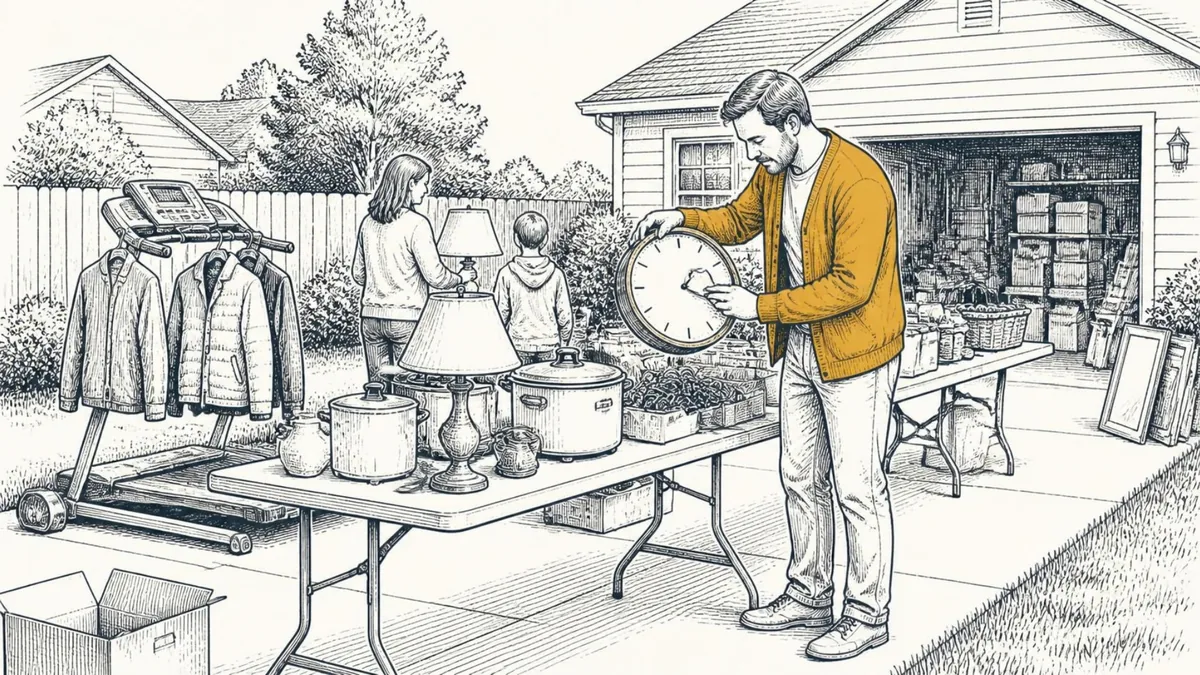
The yard sale always starts the same way. You carry a few boxes out of the garage on a Saturday morning, sure it'll be a small one. By ten o'clock the whole driveway is covered. Three slow cookers. A treadmill that's been a coat rack for years. A box of chargers for devices nobody owns anymore. A wall clock you don't remember buying.
None of it looked like clutter in the house. Each thing had its own drawer or closet, and each one had a reason to be there, at least once. It's only when everything is out in the sun at the same time that you see how much there is, and how little of it you'd buy again.
Your calendar works the same way. You see it a week at a time, and a week always looks reasonable. Busy, sure, but every block has a reason. The standing meeting you inherited from someone who left. The check-in for a project that shipped in the spring. Each one made sense the day it went on.
Carry everything out
Every December or January, I end all my recurring meetings. Every one of them goes out on the driveway.
Ending them all is easier than reviewing them one by one. Look at a single meeting on its own and it can always explain itself. The treadmill was a good idea once, too. Put everything out at the same time and the question changes. You stop asking whether this one meeting should keep going, and start asking what you want to accomplish next year and what that needs from your time. ("The yearly dry dock" is about that question, and why the answer changes from one year to the next.)
What gets carried back in
Things go back in the house on purpose. Meetings should too.
A cadence comes back when it serves what I'm trying to accomplish that year. A meeting that fit a season of growth may not fit a year of buckling down financially. A year where I want to get close to customers needs open time, and a grid full of internal syncs won't leave any. So the meetings that come back can look quite different from one year to the next, and some come back in a different shape from the one they left in.
Plenty of meetings come back. That's fine. They come back because I chose them, and I know what each one is for.
The flag football season
Here's what the teardown is really for.
When my kids started playing sports, I revisited my recurring meetings. I wanted to coach my oldest son's flag football team for a season, and that meant adjusting my meeting schedule. A team of kids doesn't reschedule practice around your standing sync.
Try to squeeze something like that into the calendar you already have and it won't fit. Every slot is spoken for by something with a perfectly good reason. It fits when it goes in first and the meetings arrange themselves around it.
That's how you make time for family, and for breaks. Neither survives as leftovers. They have to be among the first things carried back inside, before the meetings get a turn.
Every block had a reason once
Clutter comes back. New things arrive every week, each with a perfectly good reason, and by autumn the driveway would fill up all over again. That's why I do it every year and not once.
It's also why I watch meetings in the companies I work with. When an organization starts drifting, the meetings are where it shows first: more and more conversations about what's happening, less and less action. ("Look for the drift" goes into that.) A personal calendar drifts the same way. Nobody decides to fill it with things that don't matter. It just fills.
Where the metaphor breaks
Things at a yard sale don't have feelings. Meetings have people in them. Ending a recurring one-on-one is a different act from selling a slow cooker, and a calendar notification won't cover it. Tell people what you're doing and why before the cancellations land.
Some of what looks like clutter is quietly holding something up. A weekly meeting that never makes a decision might be the only place two teams actually talk. Before it stays out on the driveway, ask the people in it what they'd lose.
And not everything on your calendar is yours to sell. Early in a role, or in a company with a heavy meeting culture, you may not be able to end much. Start with what you own. Then watch what you add, because that part is always yours.
Try this
- Pick a day in December or January. Before it, write down what you want to accomplish next year.
- Tell the people on the other end of your recurring meetings what you're doing and why.
- End every recurring meeting you own.
- Put the personal things back first: family, breaks, the season you want to coach. Then the meetings that serve the year's goal.
- For each meeting you bring back, write one line on what it's for. If you can't write the line, leave it on the driveway.
- By February, note which meetings you missed. That list tells you what actually mattered.
Where do you land?