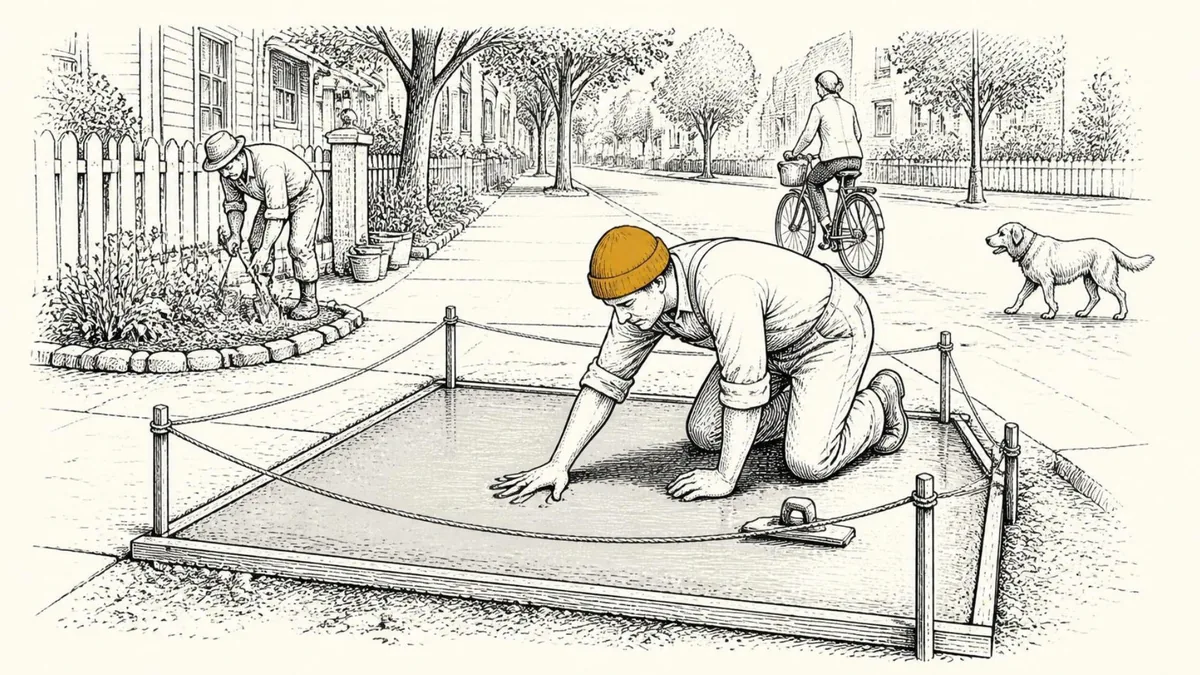
Walk down an old street and sooner or later you'll find one: a handprint in the sidewalk, sometimes initials and a year. Someone pressed it in on an afternoon long ago, while the concrete was soft enough to take it. A couple of hours later it couldn't have been done. It's been there ever since.
Now look at the front gardens on the same street. Every one has been dug up and replanted many times. Nobody agonized over the tulips. If they were wrong, they came out next spring.
Young companies make both kinds of decision every week, and mostly at the same speed. The choice of ticket tracker gets the same afternoon of debate as how the product charges. The org chart gets sketched on a whiteboard between two feature calls. That's backwards. Most of what you decide is garden. A few things are cement, and they set faster than you'd expect.
Why the cement gets rushed
Part of the problem is that cement doesn't look like cement on the day you pour it. The first pricing model is whatever the first customer agreed to. The data structure is whatever the first engineer typed on a Sunday night to get a demo working. The first senior hire is whoever was available when the team was drowning. None of these feel like foundations. They feel like getting through the week.
The other part is that garden decisions are louder. Everyone has an opinion about the chat tool. The roadmap argument has six people in it. Those debates fill the calendar because they're easy to have, and the quiet decisions that will still be there in five years get made in the gaps.
Speed is a real advantage early, and I'd never tell a founder to slow everything down. The trick is to stay fast on almost everything so you can afford to be slow on a few things.
What sets fast
These are the decisions I'd treat as wet cement in a young company. They feel provisional when you make them. A year later, they're the street everyone walks on.
Your pricing model. The price itself is easier to change than founders think. The shape is the hard part: per seat, per use, flat, per location. Customers build budgets around it, sales compensation gets built on it, and your billing system bakes it in. The same goes for the choices you ask customers to make at signup. At Meta, a business picked how it would be billed when it set up its account, and changing that later meant setting up a whole new business. ("Let them change how they pay" tells what it took to fix.)
The core data structure. What the product thinks a customer is, whether one account can hold many workspaces, how you model the thing your users care about most. Every feature after that gets built on top. Get it wrong and each new feature pays a small tax forever, or you stop everything to re-pour.
Who owns the customer relationship. Do you sell direct or through partners? Does the reseller hold the contract, or do you? Once a partner owns the relationship, the customer is theirs in the ways that count, and taking it back is a fight.
The first two senior hires. The first senior engineer and the first senior go-to-market hire decide how everyone after them gets hired, what good work looks like, and who people learn from. They also tend to hire people like themselves. Two hires shape the next twenty.
The culture you tolerate. The behavior you let slide in year one becomes the norm. If the brilliant early engineer is rude in code review and nobody says anything, rude is now the standard. Culture sets from what you allow far more than from what you write on the wall.
What stays soft
Almost everything else. Features, mostly: you can add them, change them and retire them. Tools: you can switch trackers, chat apps, even accounting software, with some grumbling. Most process: standups, planning rhythm, how specs get written. Team structure below the senior level. The design of most screens.
These deserve attention. They don't deserve the founder's sleepless nights. Plant them, see what grows, and dig them up if you need to. Better still, let the person closest to the work decide them, so the founder's attention is free for the wet concrete. ("The founder is still the roadmap" is about getting those calls off the founder's desk.)
A quick test
When you can't tell which kind of decision you're looking at, ask one question: what would it cost to reverse this a year from now?
Count it roughly. Weeks of engineering. Customers you'd have to re-contract. People you'd have to move, re-level or let go. Trust you'd spend with the team or the market. If the answer is "an afternoon and some complaining," it's garden: decide quickly and move on. If the answer is "a quarter, and some customers might leave," it's cement. Slow down. Write out the options. Get a second opinion from someone who has poured this kind before.
The test works because time is what turns a decision into cement. Almost anything is cheap to reverse on day one. What differs is how fast the cost climbs afterward, and for a handful of decisions it climbs very fast. Those earn your slowest, most careful thinking, even when everything else in the company is moving at sprint pace.
Spend your care where the concrete is still wet.
Where the metaphor breaks
Even cement can be broken up and re-poured. Companies change pricing models, rebuild data structures and replace senior leaders all the time. It's slow and expensive, and sometimes it's still the right call. "Hard to reverse" is a reason for care. Freezing is its own mistake: a founder who won't pour anything in case it sets wrong ends up with a street of mud.
The list also moves with the business. For a marketplace, which side you build first may be cement. For an AI product, the model provider you build around might be. For a services firm, the first big client's contract terms can become the template for every contract after it. Make your own list instead of borrowing mine.
Try this
- Write down the last ten decisions your team made, big and small.
- Mark each one cement or garden, using the one-year reversal test.
- Next to each, estimate how much time went into deciding it: meetings, documents, back-and-forth.
- Check whether the hours went to the cement. If the garden got them, hand garden questions to the people closest to the work and take them off the founder's week.
Where do you land?