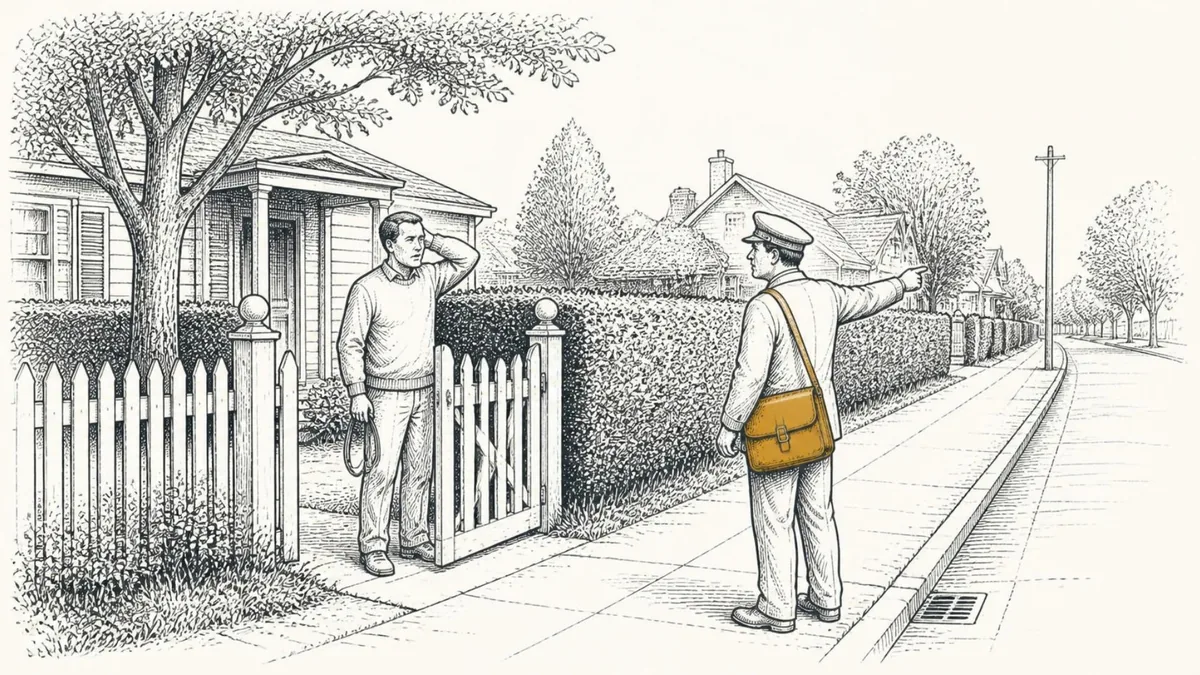
Your dog slips out the gate on a weekday morning. You could walk the streets calling her name. Or you could flag down the mail carrier.
She's been on every porch on the route since nine. She knows which yards have a gap in the fence, which neighbor leaves the garage open, where a loose dog usually ends up. Nothing about her job is about dogs. A lot of what she knows is.
When a problem is new to you, the fastest help often comes from someone whose work looks unrelated. You have to think to ask them.
During COVID, I had about a week to write contact-tracing app guidelines for the CDC. One of the most useful doors I knocked on belonged to one of the largest skip-tracing companies, the people who track down a car when someone stops paying the loan.
What the CDC needed
Man, this was a quick project. COVID caught everyone off guard. The CDC wanted guidelines it could share with states, municipalities and partners: what contact tracing should look like, and what should be the same from one place to the next.
The goal was simple to say. If people could find out who they'd been in contact with who might have the virus, you could alert a large group quickly and contain the spread faster. The people who'd been exposed could go get checked.
I wrote the guidelines myself, with one or two associates helping work out how they'd translate to the different states and partners we were working with. That was the whole writing team.
What went into the week
Research, mostly. A lot of it. Analogous situations. Mathematical models of how fast the infection moved and who might have been exposed.
The guidelines had to account for the different ways people do and don't gather. They had to sit alongside the expectations states already had for their COVID response, and the guidelines states were already putting out. And they drew on standards from fields that already deal with a compromise: working out whether one happened, who was affected and where it came from.
Then the conversations, packed into the same week. New York leadership. And companies that faced problems with the same shape as ours, which is how a car finder ended up in a public-health document.
The car finder
A skip tracer's job is to find something that doesn't want to be found. Someone defaults on a car loan, and the car isn't where the paperwork says it is. The skip tracer works it out from third-party data and possible connections: where a vehicle might be, given everything partial they can see.
Contact tracing has a similar shape. You rarely know exactly where someone was or who they stood next to. You have partial information and likely connections, and you have to reason from those to who should get a call. Some of the skip tracer's logic and strategy ended up in the guidelines for tracing and tracking COVID exposure.
Nobody would have put a company that finds cars for lenders on a list of public-health advisors. That's exactly why it was worth the call. Some of the people who'd thought hardest about this kind of problem weren't in public health at all. They were in collections.
This is how I learn anyway. Something from one place ties together something somewhere else. A crisis just removes the option of waiting for the connection to show up on its own. You go looking for it.
Small pen, big room
The week worked because of two choices that pull in opposite directions.
The writing stayed in very few hands: mine and one or two associates. One small group writing means the document has one voice, and nobody waits on a committee to agree on a sentence.
The conversations went wide. New York, the skip tracer, and others. A wide room means the document reflects the people who'll have to use it, and the people who've already solved a piece of it somewhere else.
Then the first version went out, and the real work started. The guidelines got revised over many conversations running in parallel. Follow-on conversations included Salesforce, a state's senior leadership, and a city mayor and their team, each working out what it would look like for them and how they might approach it.
In the end the guidelines were used by Apple, Samsung, Salesforce and many others.
A week is enough to write something useful if you stop treating version one as the final word. Write it to be revised, and line up the people who'll revise it with you.
Whether to build the app ourselves was a separate decision. We said no, and "Shipping under constraint" tells that part. The capability that made the week possible started out as an innovation lab, which I'd evolved into an incubator and a rapid-response capability. "An innovation lab is not an incubator" is about why that change mattered.
Where the metaphor breaks
The mail carrier helps because she already knows your street. The skip tracer didn't know anything about viruses. What carried over was a method, and a method has to be translated before it's any use to you. A car doesn't cough on the car parked next to it. You take the logic and leave the rest behind.
And a neighbor helps you find one dog, once. Guidelines like these don't stay written. The first week was the start, and the revising kept going in all those parallel conversations after it. If you borrow from an unlikely neighbor, plan to keep going back.
Try this
- Write the problem you're stuck on in one sentence with no industry words in it. "Work out where something probably went, from partial information" is the kind of sentence you're after.
- List every industry you can think of that solves that sentence every day.
- Call someone in one of them this week. Ask how they'd approach it, then ask what they'd never do.
- Keep the writing to one or two people. Keep the list of conversations long.
- Ship the first version with the date of its first revision already on it.
Where do you land?