Picture a big company's innovation demo day. The room is full. The prototypes are clever: say, a voice assistant for field technicians, a pricing model nobody in the industry has tried, an app that does in four taps what used to take a form and a phone call. People clap. Someone from the executive team says this is exactly the thinking we need.
A year later, almost none of it is for sale.
The lab didn't fail. It did what labs are built to do, which is make new things. What the company didn't build was the next room: the place a new thing goes after it's invented and before it can survive on its own.
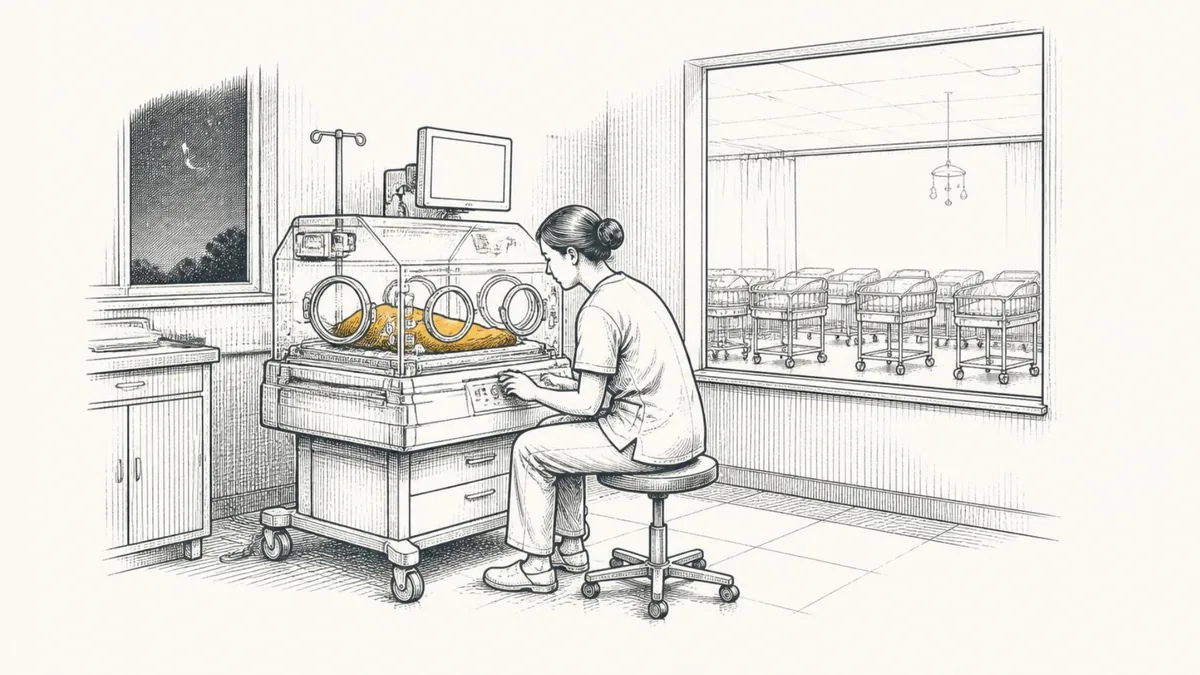
When my daughter was born early, she started life in an incubator. A little clear box. It helped her breathe. It kept the warmth and the air and everything around her right, so the only job she had was to keep growing. When she could sustain herself, they moved her out of the box.
The people around that box were experts in one thing: helping something small and early become strong enough to leave. They watched the numbers, adjusted the conditions, and knew when she was ready, which mattered as much as anything they did.
That's the difference between an innovation process and an incubation process. Most large companies have the first and assume the second will happen on its own.
What a lab is built for
A good innovation lab is a machine for producing possibilities. It's staffed by inventors: curious, fast, bored by anything that already works. Its output is a prototype, a pilot, a deck with a working demo at the end. All of that is useful. You can't incubate something nobody invented.
But look at what a prototype has proven. It shows the idea can work in a controlled setting, run by the people who believe in it most. It hasn't shown that customers will pay a price that covers the cost, that sales can explain it, that support can handle it at two in the morning, or that it fits the systems and contracts the company already runs on. Those questions decide whether something becomes a product, and the lab was never set up to answer them.
Where good inventions die
Usually the prototype gets handed straight from the lab to a business unit. That unit is a mature organism with its own metabolism: revenue targets, margin floors, a roadmap that was full before the lab showed up, a sales team paid on what closes this quarter.
So the new thing gets judged by grown-up standards on day one. It's small, so it loses every prioritization meeting. Nobody's bonus depends on it. The inventors have already moved on to the next idea, because that's their job. Six months later someone asks what happened to the field-tech assistant, and the honest answer is that it stopped breathing somewhere between the lab and the business, and nobody was watching.
What an incubator does
An incubation process is the clear box. It controls the conditions: protected funding with an end date, shelter from the core business's metrics, a small dedicated team instead of borrowed hours. It watches a short list of vital signs on a schedule (customers paying full price, a repeatable way to sell, unit costs heading the right way). It decides when to adjust and when to let go. And it writes down, before the product goes in, what ready to leave the box means.
It also grows two things at once: the product, and the team that will champion it once it's out. A product that graduates without people who can run it, sell it and fight for it in the business unit's meetings is headed back into the box.
Choosing what goes in the box
Not every idea deserves a bed. At Guidehouse I evolved the innovation lab into an incubator and a rapid-response capability, and we judged candidates through five lenses before anything went in.
Client impact. What does it do for the client relationship, for winning the work in front of us, for the client's outcome, for future work and long-tail revenue?
Differentiation. Is it a differentiated offering in a market we know? Does it give us a case study nobody else has? Can it scale into something that keeps producing revenue?
Productization or expense reduction. Could a working version lower the cost of delivering a service that already makes money?
Skills fit. Would the lab need new skills just to prototype it? Would the effort build skills we'll want later anyway?
Investment and risk. What will it cost, how long will it take, and how much risk can we stand, on time and on capital?
Asking the same five questions of every candidate does a lot of quiet work. Weak ideas get stopped early, before anyone has fallen in love with them. And the ideas that do go in arrive knowing what they're there to prove.
Staff it with incubators
This is the part most companies get wrong, even when they build the box. They staff the incubator with the lab's people, because those people know the product best.
Inventors are rarely the best incubators, for the same reason a brilliant obstetrician isn't the person you want running the neonatal unit. The skills are different. Incubators are good at the dull, essential middle: pricing a new thing, getting it through legal and security review, finding the first ten customers who aren't friends of the project, reading the numbers honestly, and recognizing when something is ready to stand.
At Guidehouse we put it plainly. We wanted to become a great incubator, not just a great innovator. The usual model was to find someone, build up a lot of context and expertise, and have the experts build what they thought mattered. We got good at coaching teams instead: helping them pin down quickly the key opportunities, the key risks and what they were actually trying to accomplish, then find a lean version of something valuable that could be done in a short time, and build from there. Zero-to-one launches got 70% faster.
That rapid-response capability is also what the CDC used to create its contact-tracing app guidelines during COVID. ("A week to write the rules" tells that story.)
So staff incubation with people who are good at incubating. Pair them with the inventors early, then let the inventors go back to inventing.
A lab gets it born. An incubator gets it home.
Where the metaphor breaks
Here the picture has to stop, and it's the most important part of the essay. A neonatal team fights for every child. A corporate incubator shouldn't fight for every idea. Most new products ought to be stopped, and an incubator that never stops anything is just a slower lab. The point of the box is to give each idea a fair chance to prove itself, then be honest about what the vital signs say.
Time in the box works differently, too. Stay too long and a product gets used to protection: a budget nobody questions and metrics nobody else is held to. Set a date, and make leaving the box the default.
And not everything needs the box. Some inventions belong straight in a business unit, because they improve something that unit already sells. Incubation is for things new enough that the existing business would smother them.
Try this
- List everything your lab produced in the last two years that got as far as a pilot.
- Next to each, write where it is now: for sale, quietly dropped, or still "in discussion."
- Find the stage where most of them stopped. That's where your company needs an incubator.
- Run your next promising pilot through the five lenses before it starts, and write down what "ready to leave the box" means: paying customers, a margin, a team that can run it.
- Name one person to own incubation for it who isn't the inventor, and give them a budget with an end date.
Where do you land?