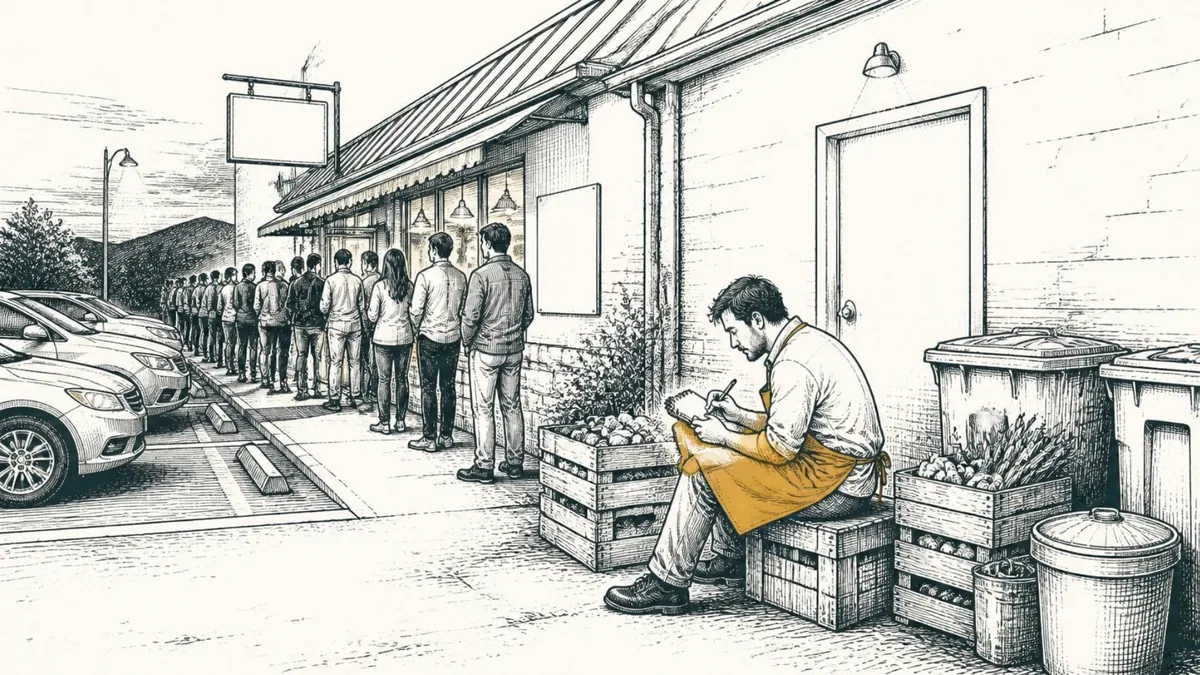
Drive past a place with a full parking lot and you assume it's doing well. Most people would. The lot is easy to see. What each of those cars cost the business to serve is invisible from the road.
A food-service owner I know built a small restaurant from the ground up. A fantastic business. The goal was to sell out every day, and most days it did. People came for the rotating menu and the special offerings. It was busy. It was not profitable. The owner was working an insane amount and not getting anywhere.
The plan was simple: if I had this many customers, I could open another location. So they pushed hard. Over twelve months, they doubled their customers.
They still couldn't open the second location. They were killing their margins.
Doubling didn't fix it
On paper, the margin on each dish looked decent. The trouble was everything around the dish.
Every menu change left waste behind: ingredients for the item that just got discontinued, bought for a dish nobody would order again. Every new item meant retraining the team, and the menu changed constantly, so the retraining never stopped. And the owner kept pouring time into inventing the next offering. All of that cost money and time, and none of it showed up in the margin on a single plate. They were losing money.
So twice the customers meant twice as much business running through the same expensive machine. A fuller dining room, and nothing left over.
It's easier to see in food service, where the waste is sitting in a bin out back. But businesses everywhere confuse being busy, or having lots of customers, with making money.
What does each one cost?
You'll hear owners say they'd rather have 1,000 people giving them $1 than 10 giving them $100. Maybe. That may or may not be true, and the only way to know is to ask what it costs to deliver each one. If every $1 customer costs you $1.10 to serve, a thousand of them is a quick way to go broke.
Look hard at the small number too. Are you having 10 customers because that's all you can service, or because that's all that will buy your product? Those are two very different things. One is a capacity problem you can fix with people, space or process. The other is a demand problem, and working harder at the same thing won't touch it.
To see any of this, count the costs that don't arrive labeled. For the restaurant, that was the waste from every change, the hours spent retraining and the owner's own time. In a services business it's the extra calls, the rework, the client who needs a meeting before every decision. Put a rough number on each, even a bad one, and add it to what you think a customer or a product costs. The list of what makes you money usually reshuffles.
Small on purpose
José Andrés runs a restaurant in Washington, DC, called Minibar. It's a tiny tasting counter. When I last booked, the reservation window opened months out and filled in minutes.
He has much bigger restaurants. This one stays small anyway, and it's hard to call it short of customers. As far as I can tell, it's built around the number of people it can serve the way it wants to serve them, and the demand for that is enormous.
That's the opposite of the restaurant I started with. Both sell out. One picked its size and built a business around it. The other kept adding customers and hoped the business would follow.
What busy is supposed to get you
The notion of being busy is a misnomer for what you're actually trying to accomplish.
You want to provide value to your customers. You want to be viable over the long term. And you want the business to provide value to you as the owner. Are you making money? Will you be able to retire? Can you take a break? Are you fulfilled? Is it making a better, more stable life for your family?
Busy doesn't, by itself, accomplish any of those things. It has to be put into context.
If the busy months are also the months you're short on cash, "Cash is water, and timing is the pipe" picks up from here.
Where the metaphor breaks
A full lot isn't always hiding a problem. Some low-margin customers bring in the high-margin ones: the regular who books the party of twelve, the small account that refers your best client. Their own numbers undercount them. Before you cut anything, ask what it brings with it.
The rotating menu was what people came for, so cutting it was never the answer. A business like that can keep rotating. What has to change is the cost of each rotation: fewer swaps, dishes that share ingredients, specials priced to cover the waste they leave behind.
And a parking lot tells you nothing about the owner. You can't see from the road whether the person running the place has had a day off this year.
Try this
- Write down what busy is supposed to get you: an income, a second location, time off, whatever it is. Be specific.
- List your products or services and the obvious margin on each.
- Next to each, add the hidden costs: waste, training, rework, and your own hours. Guess where you have to.
- Re-rank by what's left. Circle anything that dropped.
- For your busiest offering, ask whether customers are limited by what you can serve or by how many want it.
- Before you add capacity, fix the most expensive hidden cost.
Where do you land?