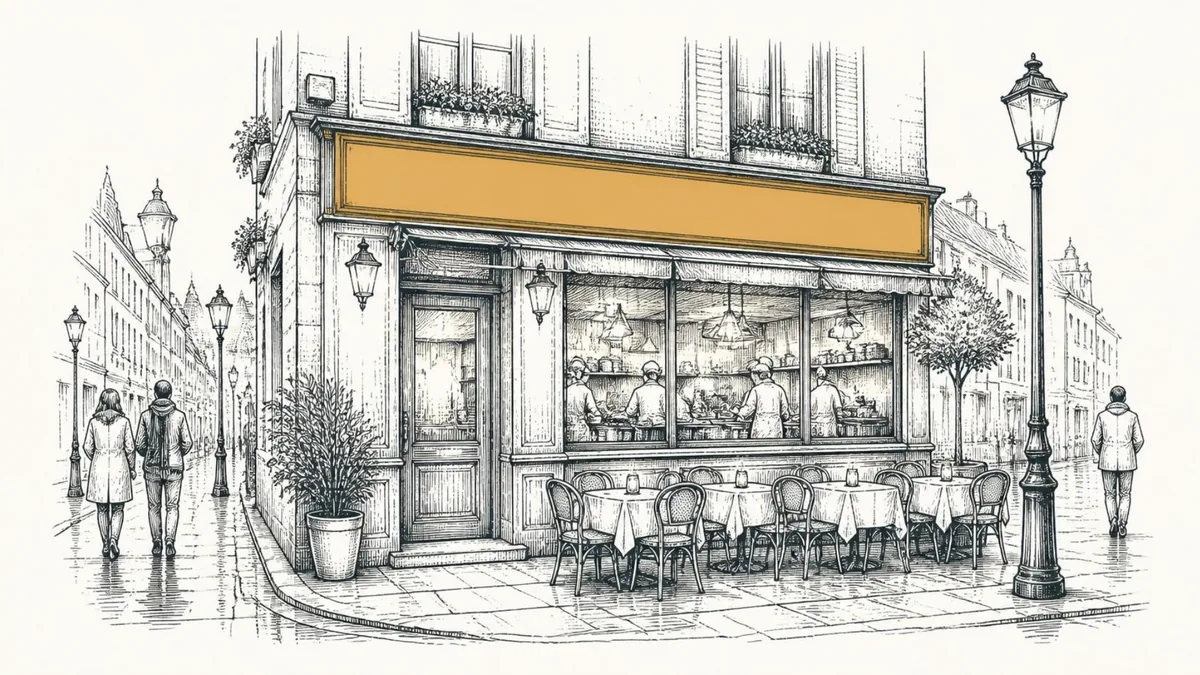
A restaurant can have the best kitchen in the city and still be empty if the sign out front says "Food."
Most companies run the sign and the kitchen as two departments. Marketing owns the promise. Product owns the delivery. Customers don't know there are two departments. They read the sign, decide whether it's for them, and either walk in or keep walking. The sign is the first screen of the product, whoever painted it.
I got to see that from both sides at PenFed. I was VP, Digital & Innovation, and for about a year I was also interim CMO.
What I walked into
The marketing organization needed a digital transformation. Advertising was largely paper-based. The whole department had been set up for newspapers, and a lot of things just weren't done the modern way.
There weren't really campaigns, either. The pattern was to push one type of product hard at the start of the year, spending about 50% of the entire marketing budget in the first two months, then coast the rest of the year: buying newspaper ads and figuring things out as they came. There were no customer segments. The branches weren't connected to marketing at all, and were simply not modern.
The sign said the wrong thing
Then there was the name. PenFed was still going by Pentagon Federal Credit Union, and people assumed it was only for the military. That wasn't who made up most of the membership, or who the organization was mainly going after. PenFed wanted to serve the military family, plus a number of associations whose members qualified. And it kept acquiring other credit unions, so it needed a brand that could bring their members in cleanly.
So beyond being an aged brand with an aged look, the name didn't represent where the organization was going. For a lot of people who'd have been great members, the sign out front said "not for you."
We rebranded the entire organization: visual identity and voice. Then we reinforced it. A jingle for radio. And we moved into TV, with a simple tactic: we bought 15-second spots instead of 60-second spots. A 15 costs less than a quarter of a 60. That let us look for creative activations, each tied to a specific goal, instead of one big expensive moment.
Brand awareness went up 700%, measured by an outside firm we hired to measure brand recognition before and after. That was the initial impact, within the first six months. Some measures went much higher later.
Year-round, and to someone
Instead of spending half the year's budget in two months, we moved to campaigns that ran all year, aimed at growth.
That took building things that didn't exist. We created an email marketing and campaign management competency, with the tools and workflows to run it. We created segments, for the first time, and started building personalization on them. And we connected the branches: screens in the branches running marketing materials from one central place.
Analytics turned spending into investing
The biggest change was the marketing analytics team. Once it existed, we knew the lift of every campaign. If we spent $100 on a campaign, how effective was that $100? Did it return anything? What did it look like per product, per market?
We experimented across direct buys, literally going to websites and buying ad space, and broader platform placements. We could target exactly what we needed. If we wanted more auto loans, we could reach people who fit that profile. Marketing became connected to the diversification of the loan portfolio and the risk the organization wanted to carry.
Eventually we could project accurately: spend this much, expect this lift in deposits. If the organization needed more deposits, we could say what a push would look like and what it would cost. Put that next to product changes, like knowing what moving a rate does to application completion or traffic, and you can make a real choice: spend on margin, through the rate, or spend on marketing.
The way I put it: "Without analytics, your marketing is not an investment, it's an expense. It's a line item going out, and you don't know what it's getting back for you."
That lesson travels well past banking. Any small business needs to understand who's buying from it. One big customer buying everything isn't automatically good long term ("The anchor tenant" goes into that). You may want to diversify. You can't, unless you know who else might buy, what buying looks like for them, whether it costs more to win them, and what each one is worth over time.
The branch is a screen too
We redesigned the branches in the same stretch. Some had very long lines, in Puerto Rico and around DC especially, with tellers behind very large desks. We put cash recycling machines at every teller station so nobody walked back and forth to a vault or counted money by hand under pressure. We added stations in the main area so a manager could open another one when the line grew. More stations meant more conversations, and more chances to tell members about products they didn't know we had.
Many branches are on military installations, some outside the US, in places like the Pacific. Walking into one should feel like a bit of home. And the people who work there deserve better too: mats to stand on, screens they can raise, lower or flip to fit them.
What I took from it
That banking experience turned out to be incredibly helpful later, in product work and in management consulting. I learned to balance fiscal impact, cash-flow impact, and product and growth impact, because I'd had to do each of them, very specifically. The segments from marketing analytics also informed how we personalized the mobile app ("Outsourcing is a loan" has that side).
The first thing a customer ever sees from you is a product decision, whether or not product made it.
Where the metaphor breaks
A restaurant sign is one thing, painted once. A brand is every touchpoint at the same time: the TV spot, the jingle, the email, the screen in the branch, the app, the statement in the mail. You can't fix it by repainting. You fix it by making each of those moments part of the same story, and by measuring what each one brings back.
And a great kitchen with a bad sign at least has regulars. The risk with a sign that says "not for you" is quieter: you never meet the people who believed it.
Try this
- Read your name, tagline and home page as a stranger would. Write down who they'd assume it's for. Compare that with who you actually want.
- Pull last year's marketing spend by month. If most of it lands in a few weeks, ask why.
- For your three biggest campaigns, write down what each one returned. If you can't, that's the first job for analytics.
- Pick one product and work out what more demand is worth to you through marketing versus through price. Then decide which to spend on.
- Walk your own front door, physical or digital, and count how many places the story changes.
Where do you land?