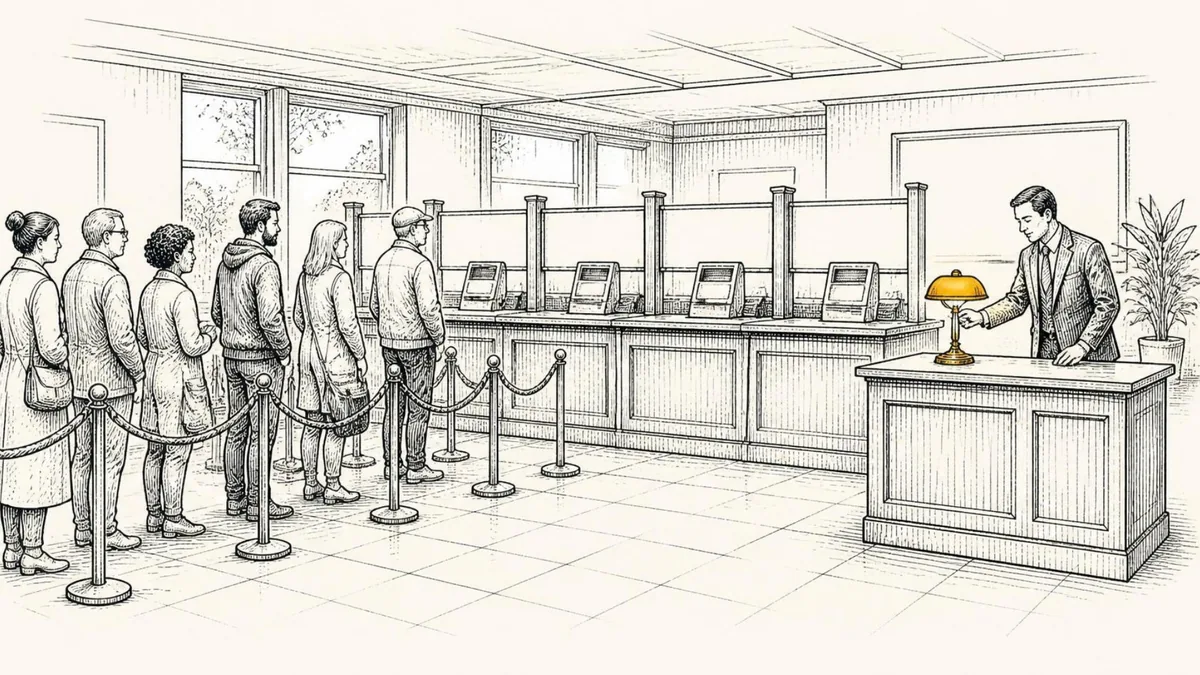
When I redesigned the branches at PenFed, the problem you could see from the door was the line. Some branches had very long lines at times, in Puerto Rico and in parts of the DC area especially. You walked in, you waited, and eventually you reached a teller behind a very large desk.
The fix was to make every station faster, and to make the branch able to stretch.
Every teller station got a cash recycling machine, so tellers weren't walking back and forth to a vault or counting every bill by hand. And we added stations out in the main area, beyond the teller row, so a manager or supervisor could open an extra one when the line grew. More bandwidth when it was needed, and a better view of what was happening on the floor. It had a side effect I liked: more conversations with members, and more chances to tell them about things they didn't know we offered.
That extra station only works if the manager can do the work. A supervisor who can only supervise can't open the lane.
I think about hiring that way now. I didn't always.
The designer who only worked one way
Early in my career I got one of my first chances to hire. I brought on a designer who looked great on paper. Nice portfolio. All the right process language. I assumed that if they could do the work in that portfolio, they could do anything.
Not the case. They worked according to their process, and only their process. And the portfolio turned out to be one specific type of work, done well, over and over. Anything outside that shape was a struggle.
I'd hired for the role on the page. The page was accurate. The job was bigger than the page, the way jobs on small teams always are.
Hire the person
What I learned was the value of T-shaped people: deep in one thing, able to stretch across others. For a role that carries a lot of weight, hire an expert in the thing, or someone who can expand into it.
When I was younger, I hired to fill a role. Now I hire a person who can fill the role. It sounds like a small change in wording. It changes the whole interview.
Hiring for the role means checking a list: do you have the specifics on this piece of paper? Hiring the person means finding the best person you can, someone who'll cover the role and the things around it, and who can think like the teammates on either side of them. A designer who can think like a product manager, which is insanely valuable now that AI lets designers build. An engineer who can think like a strategist. Someone in finance who can think like a product owner, or like a technical leader.
You still want people who can do the role. But you're hiring the person. I hire people, not roles, now.
The breakout role
Actors talk about their breakout role. Often it's a TV actor's first big movie part, and the story goes the same way: they came in and redefined the character. The writer and director had one idea of who that person was, and the actor expanded it. Those are the best performances. The person fits the need so well that they grow into it, then bring things nobody wrote down.
That's the hire you want. Someone who reads the part and sees more in it.
It's also a reason to write the job description around the need. If the page lists twelve tools and five years of one exact kind of work, you'll get someone who matches the page. If it describes the problem, the person who can redefine the part has room to show you.
Find the line first
None of this means hiring generalists for everything. Start where the work waits.
In a small company the line usually forms in one of three places. Work waiting on the owner: proposals, approvals, escalations only one person can handle. Work waiting on a skill nobody has: the website nobody can touch, the follow-up nobody knows how to run. Work waiting on capacity: you have the skill, just not enough of it.
The tell is the same each time. Something sits in a queue, and there's a customer or a dollar on the other side of it. Ask your team where the line is. They know, because they're the ones apologizing for it.
Hire for the longest line. Then look for the person who can open the next one too, because the line moves. On a small team it can move every quarter. A branch can't know exactly when the line will get long, so we built stations a manager could open. You can't predict where your next line will form, so hire people who can step to another station.
Give them a station
One more thing from the branches. The redesign was partly for the people who worked there. Mats to stand on. Screens that could flip, rise or lower to suit whoever was at the station. Cash recyclers that took away the angst of counting money under pressure with a long line watching.
A great hire still needs a decent place to stand. If you hire someone who can work more than one lane, give them what they need to do it: the tools, the access, the context, and permission to step out of their lane when the line forms.
Where the metaphor breaks
A branch manager can open a station in a minute. A new hire can't. Most take months to get up to speed, and somebody has to train them, often the very person whose line you were trying to shorten. Plan for the dip, or you'll decide the hire failed in week six.
A T-shaped person can also get pulled into every lane at once. The manager who opens a station still has a branch to run. If your best stretcher spends every day covering gaps, the deep part of the T wears away. Choose which lanes they open.
And some lines don't need a person at all. If the wait comes from a clumsy process, a better tool clears it, the way the cash recyclers did. Check that first. It's cheaper than a salary.
Try this
- For one week, write down every place work sat waiting: what it was, who it was waiting for, and how long.
- Sort each item: waiting on the owner, waiting on a missing skill, or waiting on capacity.
- Before you hire, ask whether a better tool or a simpler process would clear the longest line.
- If you do hire, write the job description around the problem. Then name the two neighboring roles you'd like this person to be able to think like.
- In interviews, ask for a time the candidate did good work outside their job description, and what happened next.
Where do you land?