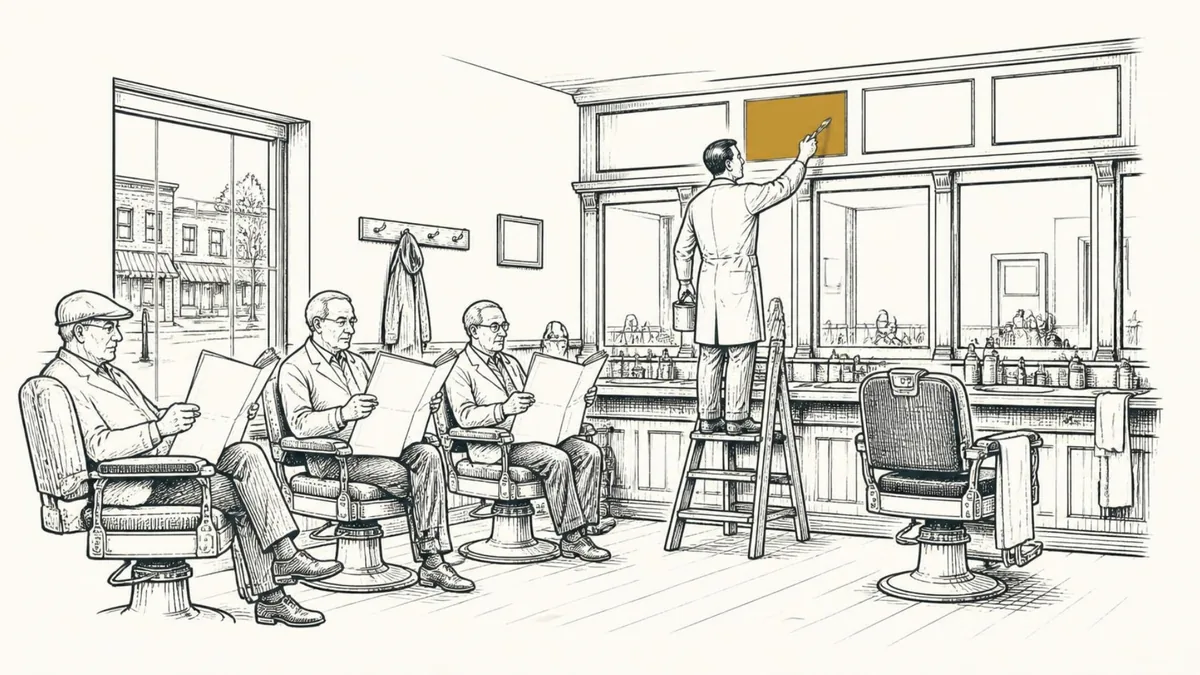
Picture a barber shop with a price board on the wall above the mirrors. Cut, $25. Cut and beard, $35. Kids, $18. It hasn't changed in six years. The barber has watched rent go up, supplies go up, everything go up. He thinks about changing the board about once a month. He never does, because he's sure everyone will notice two more dollars on a haircut.
Ask his regulars what a cut costs. Most of them can't tell you. They know it's good. They know which chair is his, and that he remembers how they like it. They stopped reading the board years ago.
Small business owners do this with pricing all the time. Costs climb every year. Prices stay where they were set, and margin drains out the bottom. Most of the fear is about something customers aren't looking at.
What customers actually read
I learned this in middle school, selling candy and gum out of pencil boxes with my friends. ("Your first price is a guess" tells the whole story.) We sold the common stuff cheap, and that brought people to us. The special things, treats from the international market or homemade, we priced much higher. Nobody knew what any of it cost us. Because our prices on the everyday items were great, they assumed the special price made sense too. They paid based on how valuable it was to them, and how good it tasted.
That's still most of pricing. People mostly read the value. They read the number when something makes them look: a big jump, a surprise fee, a reason to wonder whether they're being taken.
Why owners wait
Fear of losing customers. The picture in the owner's head is everybody walking out at once. That almost never happens, but it's vivid, and vivid beats likely.
Guilt, especially with longtime customers. As if loyalty were a promise never to charge more.
And markup. Plenty of owners set a price years ago by adding a markup to what things cost then. Costs have shifted in a dozen small ways since, and nobody added them up. If you don't know what a haircut costs you today, the raise never feels urgent.
Underneath all three, nothing forces the decision. A price stays put until somebody changes it, and changing it is always next month's job.
Price on the value
Markup ties your price to your costs. Value ties it to your customer. I'd rather price on value, for two reasons.
It pushes you to look for ways to provide better value, because that's where the price comes from. And it makes pricing variable. You're no longer stuck at "I can only do this on a markup." Your margins get more room, and more room means you can do more: invest in the work, pay people better, try something new.
Value pricing means knowing what your work is worth to the people who buy it, and pricing close to that. Charging whatever you can get away with is a different habit, and customers can smell it.
Know what a price change does
A price you never measure is a guess you keep repeating. You need some way to see what happens when the number moves.
When I built a marketing analytics team at PenFed, one of the things it made possible was marrying marketing with product changes. Rates are a lender's prices. Once you know what changing a rate does to application completion or traffic, you can choose between spending on margin, by offering a better rate, or spending on marketing, and compare the two. The way I put it: without analytics, your marketing is not an investment, it's an expense. It's a line item going out, and you don't know what it's getting back for you. An unmeasured price works the same way.
A small business can do this without a team. Write down what happened the last time a price moved: customers before, customers after, and what the margin did.
Do the arithmetic
Before you decide a raise is too risky, run the numbers. Take a hypothetical: you raise prices 10%, and your margin is 30%. Each customer who stays now brings in a third more profit than before. You'd have to lose a quarter of your customers before you made less money than you do today, and you'd be doing a quarter less work for it.
Most owners who run that sum find they were never near the edge they feared.
Waiting has a cost too, and it compounds. Every year the price stays flat, the gap between what you charge and what it costs you gets wider, and the eventual raise has to be bigger. A small increase every year or two is easy to absorb. A big one after six years of nothing is the version that makes people read the board.
How to raise it
Start with new customers. Nobody new knows what you used to charge, so you test the price with no risk to existing relationships.
Tell existing customers plainly: what's changing, by how much, starting when, and a sentence or two on why. Give a date, thirty to sixty days out. Give a reason that's true. "Our costs have gone up" is a reason. So is "we've added Saturday hours since you started." For your longest-standing customers, you can step it: half now, half in six months.
Then don't undo it. Don't apologize, because it tells people you think the new price is unfair. Don't discount it back for whoever complains, or the low price ends up belonging to the loudest customer. And don't hide it in smaller portions or new fees. People notice that faster than they'd ever notice the board.
Where the metaphor breaks
In some markets, people really do read every price: commodities, comparison sites, procurement lining up three quotes side by side. There, a raise with nothing new attached loses the deal. The increase has to come with something, or you compete on cost, which is a different business.
Some customers read the board because they have to. A nonprofit on a fixed grant or a household on a tight budget will feel every dollar. Give more notice, offer a smaller option, and accept that you may lose a few people you'd rather keep.
And a higher price won't rescue work people are already unhappy with. If the regulars are grumbling about the haircuts, the new number gives them a reason to try the shop across the street. Fix the haircut first.
Try this
- Find the product or service you've charged the same price for longest.
- Write down what it's worth to the customer in their terms: time saved, money made, a problem gone.
- Work out what it costs you to deliver today. Count time, not just materials.
- Using your real margin, work out how many customers you could lose after a 10% increase before you'd make less money.
- Put the new price in place for new customers next month, and write down the before and after numbers.
- Write the note to existing customers now, with a date on it, and send it before you can talk yourself out of it.
Where do you land?