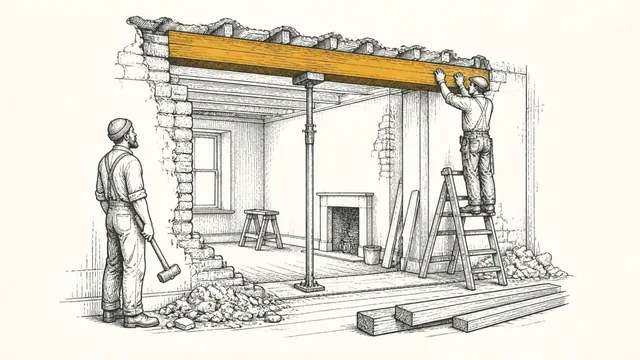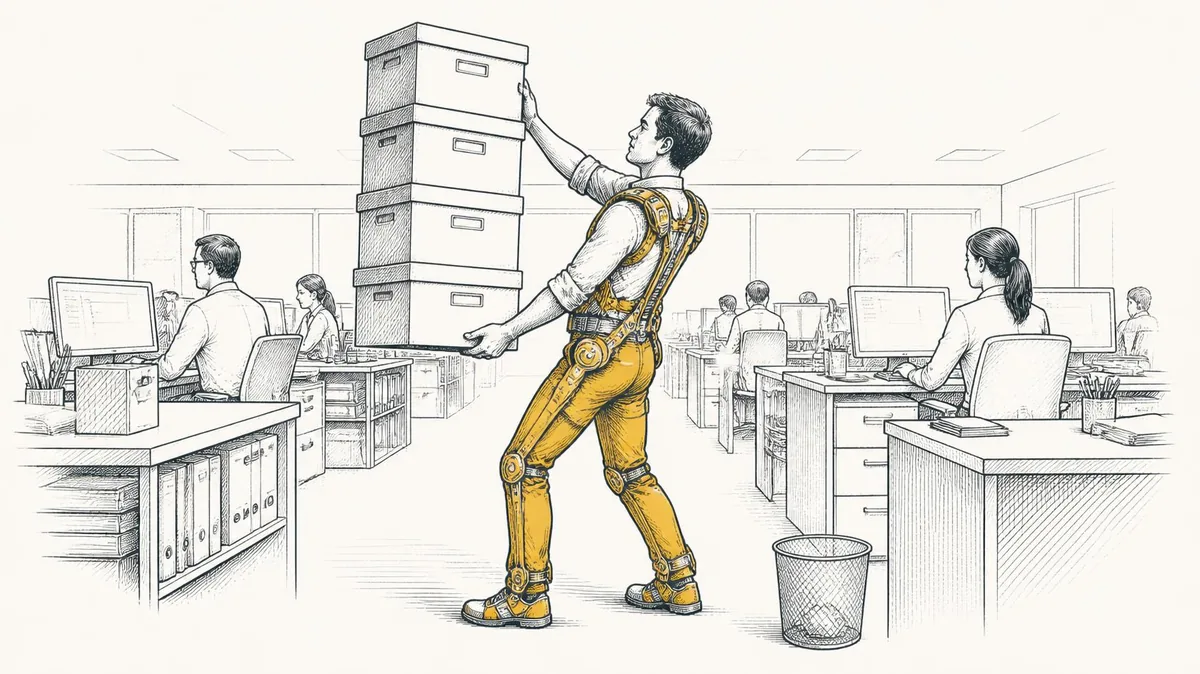
Every superhero movie with a suit in it has the same scene. The suit hangs in the workshop and it's just metal. Then somebody steps into it and lifts a car. The suit didn't get any stronger. The person inside it got reach.
That's the picture I want in the room when a company talks about AI.
Here's the picture usually there instead. It's a made-up company, but you've probably seen a version of it. Someone types a number into a finance-model cell labeled "AI efficiencies," and the number is people. Six months later most of the new licenses sit idle, the savings exist on paper, the work is slower, and the two people who really understood renewals took the package.
That's the severance-package plan. It keeps disappointing for a plain reason: the work never changed. Somebody subtracted people from a process and expected software to fill the hole.
Superpower and kryptonite
I talk a lot about knowing your superpower and your kryptonite. Your superpower you amplify. Get the supersuit, get the utility belt. Your kryptonite you protect against, and kryptonite covers more than what you're weak at. The stuff that drains you, and drains your value, counts too. You won't find either one unless you go looking.
That's what AI is good for at work. Point it at the superpower and a great analyst gets to do more of the analysis that made her great. Point it at the kryptonite and the Monday status report, the copying between systems that don't talk, the hunt for the latest version of the contract, stop eating the afternoon.
I saw how much this matters when I built an evaluation framework for product managers. What we learned after running it was that there were gaps between what people felt their aptitude was and what they were able to show. Some people were doing work they weren't great at, and the useful question turned out to be: do we need them to be great at it? Or should we give them more of the work where their superpower could really help the rest of the organization? ("Grading PMs without grading the grader" has that story.) AI makes that question cheaper to act on. You can hand the drain to the suit.
I've watched this movie before
Before this it was called digital transformation, and I spent years inside innovation work at big organizations. At Gannett I was one of five people on the Design Innovation Group, which reported to the CEO. We worked with IDEO, and Clayton Christensen ran trainings there; that's where I learned innovation from him. Later, at Guidehouse, I took an innovation lab and evolved it into an incubator and a rapid-response capability.
The pattern I watched over and over was companies taking their paper product and putting it on a website. New screens, old process. The label was doing more work than the strategy.
AI is heading for the same reckoning, faster. Two patterns worry me most.
AI as a headcount line. Finance sets the agenda from the outside in, and the question becomes "how many people can we not hire?" It fits on a board slide by Friday, which is the appeal. It's a cost play wearing a strategy's clothes.
Adoption as tool access. Everyone gets a license, maybe a lunch-and-learn. Nobody defines what success looks like for the person doing the work, nobody gets time to figure it out, and a usage dashboard counts logins. ("A gym membership isn't a workout" is about this one.)
McKinsey's report "The state of AI in 2026: On the road to ROI" (August 2026) shows where that ends up. Nearly nine in ten respondents said their organizations use AI regularly, but only 37% attributed any EBIT impact to it. The 6% McKinsey counts as high performers stand out for one habit: nearly three-quarters of them fundamentally redesigned their workflows because of AI, against about a quarter of everyone else.
People, process, product, all at once
I picked up a frame in my MBA at Cornell's Johnson School that has held at every company size I've worked at: people, process, product. Three questions.
People. What can one person now do that they couldn't before? Trust starts here, because people believe what they've felt.
Process. How does a team's way of working change when every person on it can do more? The handoffs, the approvals, the standing meeting that exists so six people can recite what a shared document already says. This is the redesign McKinsey's high performers are doing.
Product. What can customers now get that they couldn't before?
These aren't a staircase. You don't finish people and graduate to process. Companies that treat it as a sequence stall on the first step, piloting forever. You work all three at once, at different depths. Ignore people and you ship AI features built by a team that doesn't use AI itself. Ignore process and you get a building full of individually faster people stuck in the same slow handoffs.
What I wish I'd known sooner
At Wiser, toward the end of my time there, product designers started taking more agency. They suggested product decisions, and some owned specific deliveries. One designer conceived a product optimization dashboard, used AI to work out what should be in it, and built it without going through engineering.
That's a supersuit. Same designer, same judgment, a lot more reach.
AI was more nascent then, and we were still working out how AI, engineering, design and product management would fit together. I wish I'd known sooner what that designer showed us, because it would have let us do some things differently. Nobody had to be cut for that dashboard to exist. Somebody had to be trusted to wear the suit.
The two moves
Fit the suit before you buy it. Before a license goes out, pick the roles you're starting with and sit with the people in them. Write down each person's superpower and their kryptonite, in their words. Put enablement in the budget as its own line next to the licenses, with a named owner. If the training line says zero, you've bought suits for the closet.
Say where the reach goes. When people get hours back, decide out loud what those hours are for (the backlog, the customers nobody had time for, the thing only this person can do) before the finance model decides for you. Freed-up capacity with no stated purpose turns into a headcount cut by default.
Where the metaphor breaks
Some jobs do change, and some go away. A supersuit plan that pretends otherwise is dishonest, and your people will know it before the memo lands. If a role is mostly kryptonite, taking that work away changes the role. You owe that person a straight conversation and a real shot at the new version of the job.
Not everyone wants to wear one. A few of your best people will push back, sometimes because they know exactly where the tool gets their work wrong. Listen to them. They know where the suit pinches.
And a suit fits one person. A lot of the value sits in the process question, which is right where the picture runs out. There's no exoskeleton for a handoff.
Try this
- Pick one team, ideally one whose manager is curious rather than assigned.
- Get them in a room for an hour and draw two columns. In the first, list each person's superpower: the judgment calls and relationships they were hired for.
- In the second, list their kryptonite: the work that drains them. Rebuilding reports, chasing approvals, reformatting, hunting for the latest version. Put rough hours per week next to each item.
- Point AI at the biggest item in the second column first. Give the team a few weeks, examples from their own work, and one person to call when it breaks.
- Measure the hours given back, then ask where those hours went. Write the answer down.
Where do you land?